
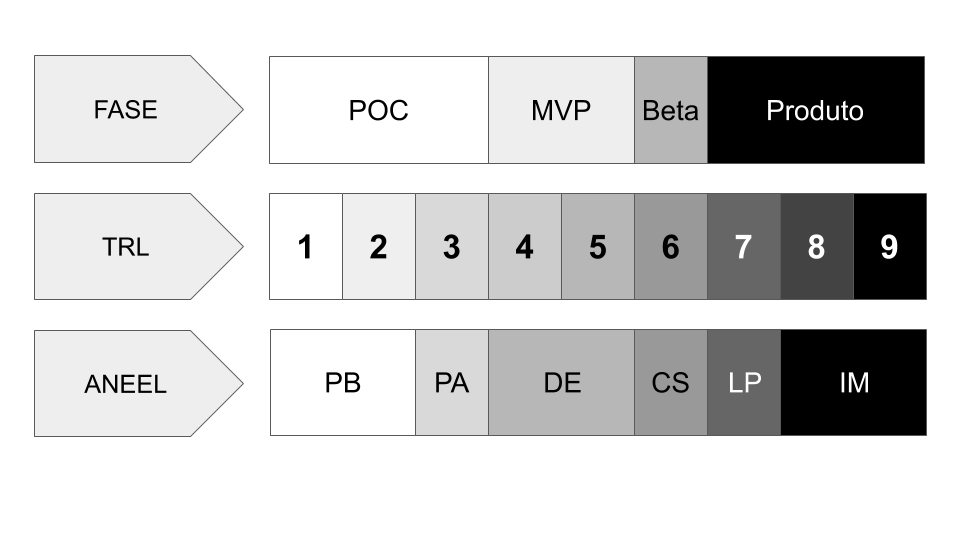
Dividing technological development into stages contributes to good planning, management and communication of the project, the estimation of its costs and the time needed for the innovation to reach the market.
There are, however, several ways of making this division, which can lead to confusion.
At Bio Bureau, we like to use the Technology Readiness Level(TRL) Scale with the steps:
- TRL#1 – Basic principles;
- TRL#2 – Conceptual model;
- TRL#3 – Proof of concept;
- TRL#4 – Laboratory prototype;
- TRL#5 – Field prototype;
- TRL#6 – Scale-up;
- TRL#7 – Pilot test;
- TRL#8 – Regulatory stage;
- TRL#9 – Market.
Many of our clients are from the electricity sector and are part of ANEEL’s innovation chain:
- PB – Targeted basic research;
- PA – Applied research;
- DE – Experimental development;
- CS – Series head;
- LP – Pioneer lot and
- IM – Market insertion.
Although these scales are well understood by technicians, they can make little sense to investors, who often enter projects at more advanced stages of development and are more familiar with the stages of product maturity:
- Proof of Concept
- Minimum Viable Product
- Beta version and
- Product
Mark Searle, from Berkeley’s innovation acceleration group, talks about another stage of product maturity, the minimum useful demonstration, or MUD, between the POC and the MVP.
In most cases, it is possible to match the scales. That’s what we did in the picture that illustrates this post.
